Orlicz functions
 - link to interactive notebooks session.
A map \(\Phi :\mathbb{R}\rightarrow \left[ 0,\infty \right]\) is said to be an Orlicz function if it is even, convex, left continuous on the whole \(\mathbb{R}_{+},\) \(\Phi (0)=0\) and \(\Phi \) is not identically equal to zero. Since \(\Phi \) is even, without loss of generality we often consider \(\Phi \) with the domain restricted to the interval \(\left[ 0,\infty \right) .\) It follows that every Orlicz function \(\Phi \) is non-decreasing on \(\mathbb{R}% _{+}.\) In this paper, because \(\Phi\) is even, we will always define Orlicz function for \(u\geq 0.\)
We will use two types of definitions of the Orlicz functions. Both work with numpy arrays as arguments and return numpy arrays.
import numpy as np
import numerical_function_spaces.orlicz_spaces as osm
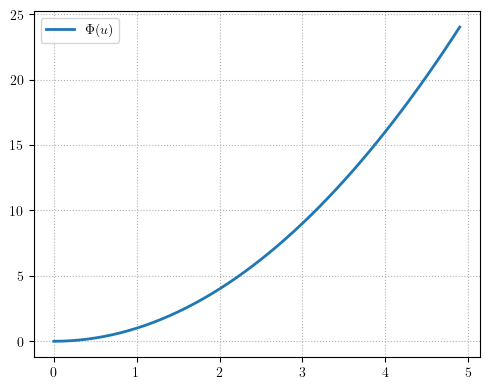
Simplest Orlicz function
def Orlicz_function(u):
    return u ** 2
Above definition works for floats and numpy arrays
print(Orlicz_function(2))
4
u = np.arange(0, 10, 0.5)
print(u)
print(Orlicz_function(u))
[0.  0.5 1.  1.5 2.  2.5 3.  3.5 4.  4.5 5.  5.5 6.  6.5 7.  7.5 8.  8.5
 9.  9.5]
[ 0.    0.25  1.    2.25  4.    6.25  9.   12.25 16.   20.25 25.   30.25
 36.   42.25 49.   56.25 64.   72.25 81.   90.25]
osm.plot_Phi(Orlicz_function, u_max=5, du=0.1)
def Orlicz_function(u):
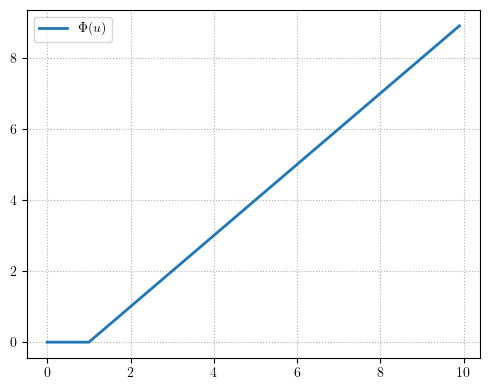
    return np.where(u <= 1, 0, u - 1)
Above definition also works for floats and numpy arrays
print(Orlicz_function(2))
1
u = np.arange(0, 10, 0.5)
print(u)
print(Orlicz_function(u))
[0.  0.5 1.  1.5 2.  2.5 3.  3.5 4.  4.5 5.  5.5 6.  6.5 7.  7.5 8.  8.5
 9.  9.5]
[0.  0.  0.  0.5 1.  1.5 2.  2.5 3.  3.5 4.  4.5 5.  5.5 6.  6.5 7.  7.5
 8.  8.5]
The same function for numpy array we may defined as
def Orlicz_function(u):
    """
    'u' should be a numpy array or function must be a little complicated
    """
    Phi = np.zeros(len(u))
    for i in range(len(u)):
        if u[i] <= 1:
            Phi[i] = 0
        else:
            Phi[i] = u[i] - 1
    return Phi
Such defined function doesn’t work for a number
try:
    Orlicz_function(2)
except Exception as error:
    print("An error occurred:", error)
An error occurred: object of type 'int' has no len()
But works for numpy array
u = np.arange(0, 10, 0.5)
print(u)
print(Orlicz_function(u))
[0.  0.5 1.  1.5 2.  2.5 3.  3.5 4.  4.5 5.  5.5 6.  6.5 7.  7.5 8.  8.5
 9.  9.5]
[0.  0.  0.  0.5 1.  1.5 2.  2.5 3.  3.5 4.  4.5 5.  5.5 6.  6.5 7.  7.5
 8.  8.5]
osm.plot_Phi(Orlicz_function, u_max=10, du=0.1)
Another examples of Orlicz functions
def Orlicz_function(u):
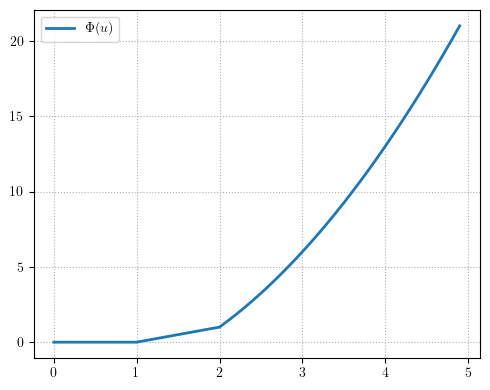
    return np.where(u <= 1, 0, np.where(u <= 2, u - 1, u ** 2 - 3))
The same function for numpy array we may defined as
def Orlicz_function(u):
    Phi = np.zeros(len(u))
    for i in range(len(u)):
        if u[i] <= 1:
            Phi[i] = 0
        elif u[i] <= 2:
            Phi[i] = u[i] - 1
        else:
            Phi[i] = (u[i]) ** 2 - 3
    return Phi
osm.plot_Phi(Orlicz_function, u_max=5, du=0.1)
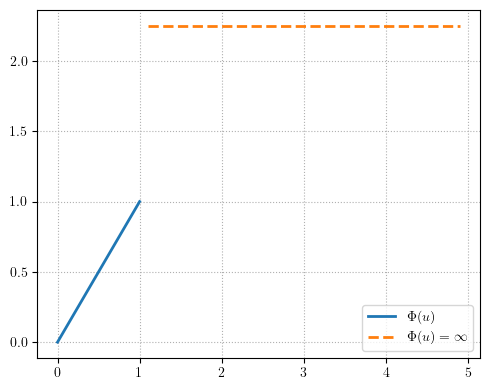
def Orlicz_function(u):
    # return np.where(u <= 1, u, np.inf)
    # or
    Phi = np.zeros(len(u))
    for i in range(len(u)):
        if u[i] <= 1:
            Phi[i] = u[i]
        else:
            Phi[i] = np.inf
    return Phi
osm.plot_Phi(Orlicz_function, u_max=5, du=0.1)
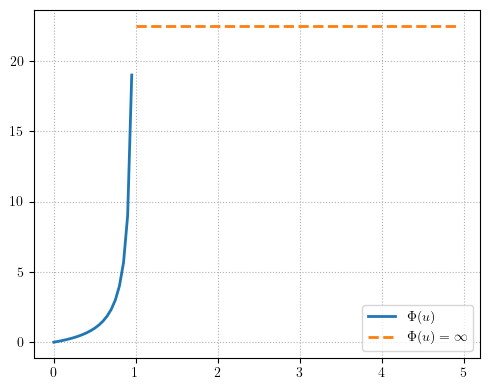
def Orlicz_function(u):
    # return np.where(u <= 1, u / (1 - u), np.inf)
    # or
    Phi = np.zeros(len(u))
    for i in range(len(u)):
        if u[i] < 1:
            Phi[i] = u[i] / (1 - u[i])
        else:
            Phi[i] = np.inf
    return Phi

osm.plot_Phi(Orlicz_function, u_max=5, du=0.05)
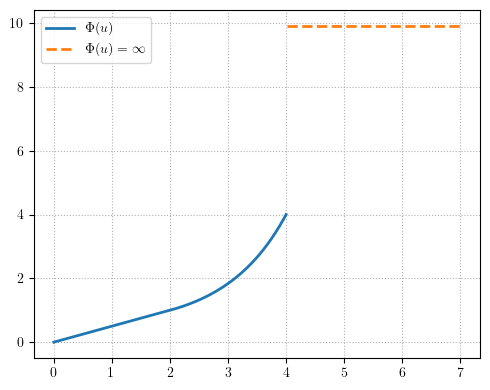
def Orlicz_function(u):
    # return np.where(u <= 2, u / 2, np.where(u <= 4, (u / 2) ** (u / 2), np.inf))
    # or
    Phi = np.zeros(len(u))
    for i in range(len(u)):
        if u[i] <= 2:
            Phi[i] = u[i] / 2
        elif u[i] <= 4:
            Phi[i] = (u[i] / 2) ** (u[i] / 2)
        else:
            Phi[i] = np.inf
    return Phi

osm.plot_Phi(Orlicz_function, u_max=7, du=0.01)
More complicated examples
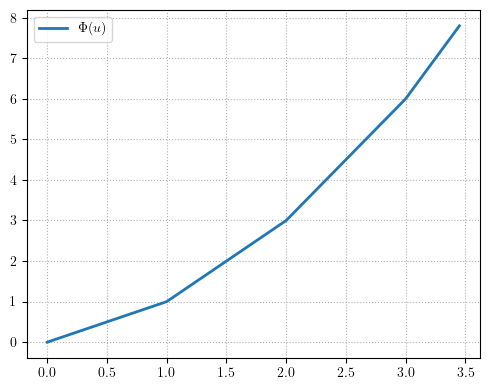
def Orlicz_function(u):
    Phi = np.zeros(len(u))
    for i in range(len(u)):
        n = -1
        while True:
            if u[i] > n and u[i] <= n + 1:  # below two conjugated functions?
                Phi[i] = (n + 1) * u[i] - (n + 1) * n / 2
                # Phi[i] = n * u[i] - (n) * (n + 1) / 2
                break
            n = n + 1
    return Phi
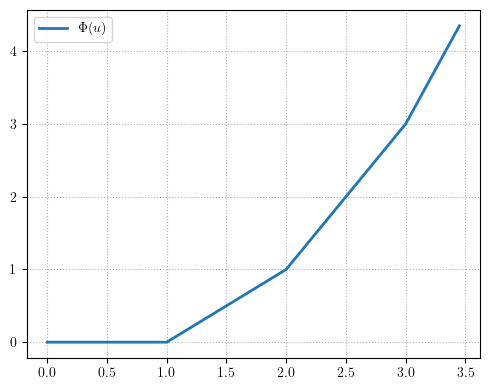
osm.plot_Phi(Orlicz_function, u_max=3.5, du=0.05)
def Orlicz_function(u):
    Phi = np.zeros(len(u))
    for i in range(len(u)):
        n = -1
        while True:
            if u[i] > n and u[i] <= n + 1:  # below two conjugated functions?
                # Phi[i] = (n + 1) * u[i] - (n + 1) * n / 2
                Phi[i] = n * u[i] - (n) * (n + 1) / 2
                break
            n = n + 1
    return Phi
osm.plot_Phi(Orlicz_function, u_max=3.5, du=0.05)